

















Manuals & Resources
Canada Dominates Cannabis Exports: CA$51.6M in February 2026
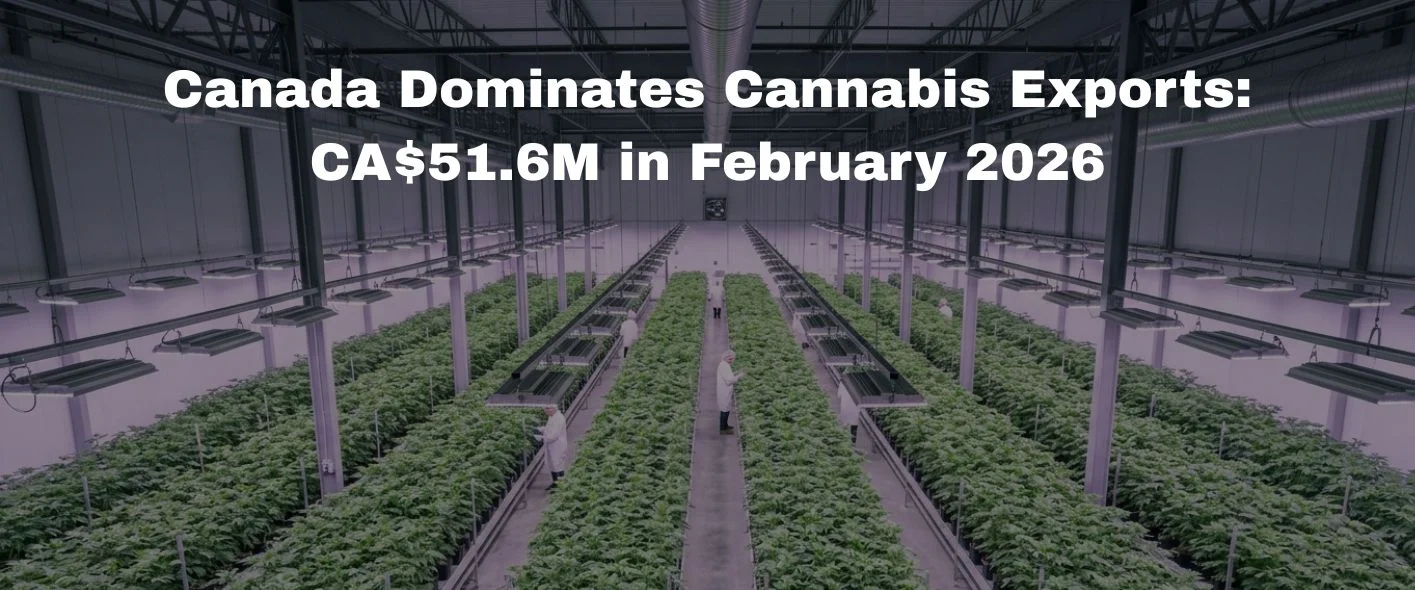

Canada remains the world’s largest exporter of cannabis products. The February 2026 data makes it clear: CA$51.6 million in total exports across the three main HS codes tracked, up 8.7% on the same month a year earlier. Behind this headline growth sits a more nuanced picture of supply chains, trade routes and emerging markets that are reshaping the global geography of cannabis.
In this article we analyse the most recent data available — drawn from Statistics Canada’s Canadian International Merchandise Trade (CIMT) web application — to understand where and how Canadian cannabis is moving globally, who is gaining ground and who is losing it.
The Data: What the HS Codes Tell Us
The analysis covers three specific HS codes that span the full spectrum of Canada’s cannabis export market:
HS 1211.90.10 — dried cannabis flower, by far the most significant segment by volume and value.
HS 1302.19.10 — cannabis extracts, a category still in the early stages of development on international markets.
HS 3004.90.10 — medicaments containing cannabis, the high-value pharmaceutical segment.
These three codes provide the most granular public view available of Canadian export flows, allowing trade routes, pricing trends and market dynamics to be reconstructed with a level of detail that would otherwise be impossible to obtain.
Portugal’s Collapse: The End of a Cycle

The most significant structural shift visible in the February 2026 data is the near-complete collapse of Portuguese dried cannabis flower imports from Canada. Portugal received CA$1.67 million in dried flower in February 2026, down 86.6% from its peak of CA$12.4 million in April 2025, and a fraction of the CA$11.1 million recorded in February 2025.
Portugal’s trajectory traces a complete cycle within the dataset: negligible imports through early 2024, steady growth to a peak between Q1 and Q2 2025, then a sharp collapse from August 2025 onwards — precisely when Germany’s direct imports began to surge.
The picture that emerges is one of a supply chain in full restructuring. Flower that was previously routed through Portuguese processing facilities for onward distribution into Germany now appears to be moving directly from Canada to the German market, bypassing the Portuguese node entirely.
A further data point reinforces this reading: there is no evidence in the extracts dataset that the lost Portuguese flower volume has migrated into processed-product exports. Portugal received just CA$4,018 in extract shipments across the entire dataset period, from January 2024 to February 2026.
Germany and Portugal: Diverging Trajectories

As Portugal retreats, Germany advances. Direct German imports of Canadian dried cannabis flower have grown steadily from the second half of 2025, moving in parallel — and in mirror image — to Portugal’s decline.
This divergence is not coincidental. Germany launched a cannabis liberalisation process with its Cannabis Act of 2024, creating structural and predictable demand for Canadian product. With a regulated market expanding and a need for reliable supply, German importers have evidently found it more cost-effective — and more legally straightforward — to source directly from Canada rather than through Portuguese intermediaries.
Germany’s trajectory suggests it is establishing itself as the primary European gateway for Canadian cannabis, with an increasingly central role in the continent’s cannabis supply chain.
Australia: A Record-Breaking Market With Prices in Freefall

If Europe is the theatre of the most visible structural shifts, Australia represents the most striking case of volume growth — and the most troubling pricing story in the entire dataset.
Australia is Canada’s second-largest flower export destination by cumulative value, having received CA$230 million between January 2024 and February 2026. That figure surpasses Portugal in cumulative terms and places Australia as the dominant market in every month outside Portugal’s peak period in early-to-mid 2025.
The volume figures tell a story of robust growth: in February 2026, Australia received 6,928 kg of Canadian dried flower, up from 2,237 kg in February 2024 — an increase of more than 200% in two years.
But it is the pricing data that commands the most attention. Through 2024 and into early 2025, Australia consistently paid CA$2.37–2.72 per gram for Canadian dried flower. By February 2026, that price had fallen to CA$1.06 per gram: a 59.6% decline in just two years, the lowest per-gram value recorded for any significant destination in the entire dataset.
This combination of sharply rising volumes and sharply falling prices has already triggered a strong pushback from Australian domestic cultivators, who are finding it increasingly difficult to compete with the flood of low-cost Canadian cannabis entering their market.
Extracts and Medicaments: The Segment That Has Yet to Take Off
Alongside the dominant dried flower market, the data on the extracts (1302.19.10) and medicaments (3004.90.10) HS codes tells a different story: that of a high-potential segment that has not yet expressed its strength on international markets.
Extract shipments to the main European markets remain marginal. The Portuguese figure — CA$4,018 across the entire analytical window — is emblematic of how the transformation of flower into value-added products is not yet following the commercial flows of the raw material.
The medicaments segment, by contrast, represents the most promising frontier for the future growth of Canadian exports. With the progressive regulation of medical cannabis across Europe — and Spain’s Royal Decree 903/2025 introducing for the first time a legal framework for medicinal cannabis use — demand for pharmaceutical cannabis products is set to grow significantly in the years ahead.
Canada: The Global Giant Redrawing the Routes
The February 2026 data confirms Canada’s unchallenged leadership position in the global cannabis market. With CA$51.6 million in monthly exports and 8.7% year-on-year growth, the country shows no signs of slowing its international expansion.
What the data makes clear is that the global market is in full evolution: routes are shortening, markets are consolidating, prices are falling and new players — such as post-liberalisation Germany — are emerging as strategic hubs in the European supply chain.
For Canadian producers, the challenge of the coming years will be to translate their current competitive advantage — volumes, costs, established infrastructure — into a durable position in markets that are becoming increasingly competitive and regulated.
Frequently Asked Questions About Canadian Cannabis Exports
How much are Canadian cannabis exports worth?
In February 2026, Canadian cannabis exports reached CA$51.6 million across the three main HS codes tracked, up 8.7% compared to February 2025.
What are the main destination markets for Canadian cannabis?
The main markets for dried flower are Germany and Australia, with Portugal losing ground rapidly from the second half of 2025. Australia is the second-largest destination by cumulative value, having received CA$230 million between January 2024 and February 2026.
Why has Portugal stopped importing cannabis from Canada?
The collapse in Portuguese imports — down 86.6% from the April 2025 peak — is linked to a shift in the European supply chain. Flower that previously transited through Portugal towards Germany now appears to move directly from Canada to Germany, eliminating the Portuguese intermediary.
Why are Canadian cannabis prices in Australia so low?
The per-gram price in Australia has fallen from CA$2.37–2.72 in 2024 to CA$1.06 in February 2026, a 59.6% decline. This reflects the strong growth in exported volumes — which have tripled in two years — in an increasingly competitive and mature market.
What HS codes are used to track Canadian cannabis exports?
The three main HS codes are: 1211.90.10 for dried flower, 1302.19.10 for extracts and 3004.90.10 for medicaments containing cannabis. The data is publicly available through Statistics Canada’s CIMT web application.
⚖️ Legal Disclaimer
This article is written exclusively for informational and educational purposes. The information provided is based on publicly available data from Statistics Canada and does not constitute financial, legal or commercial advice. BuDream does not encourage, promote or facilitate illegal activities. Cannabis regulations vary by country and jurisdiction. It is the sole responsibility of the reader to verify and comply with the local laws applicable in their country. BuDream disclaims any liability for use of this content that does not comply with the legislation in force in the reader’s country.
 Seed Shop
 Head Shop
 Vaporizers
 Cosmetics
 Growshop
 Grow Box
 Ornamental plants
 Fans and extractors
 Pots
Pots LED lamp
 Fertilizer
 Pest control