












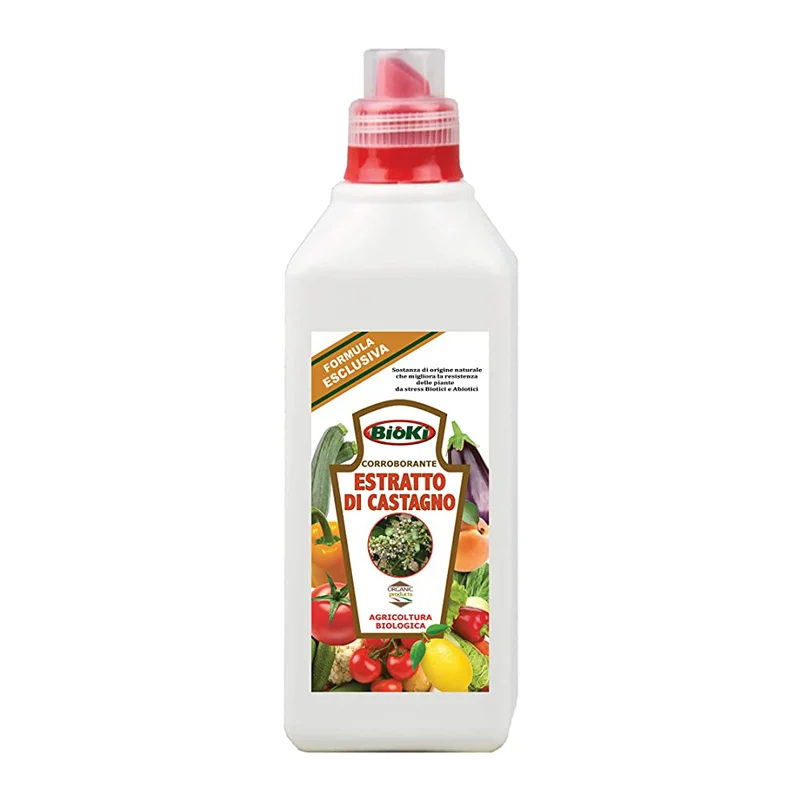

BIOKI – INTEGRAL CHESTNUT EXTRACT | 100gr
13,35 €
| Peso | 0,15 kg |
|---|---|
| Brand | ANTIKA OFFICINA BOTANICA |
Descrizione
Tannin-based whole chestnut extract, a product resulting from aqueous extraction of chestnut wood obtained exclusively by physical processes.
In plants, it acts as an efficient elicitor capable of stimulating defence reactions and activating the development of natural substances against biotic and abiotic stresses.
Plants thus grow normally even under environmental conditions favourable to the development of fungi and bacteria.
The product can be used in organic farming in accordance with EC Regulations 834/2007 and 889/2008.
Main effects chestnut extract
- Chestnut tannin forms a thin film on the vegetation that is very adhesive, nutritive, biodegradable, poorly permeable to oxygen that can reduce evapotranspiration during hot periods, reduces fruit splitting, promotes healing, improves resistance to fungal and bacterial attacks.
- The presence of polyphenols and organic acids makes it possible to improve soil structure, acidify soils with excessive pH and reduce damage due to excess salinity. The polyphenol component also stimulates the development of useful microflora (microbial antagonists) while limiting the proliferation of crop-damaging pathogens, helps limit the development and multiplication of phytophagous nematodes responsible for alterations to the plant root system thanks to its caustic action on juvenile forms and anti-feeding action on adult forms.
- The complexing properties of tannin extract also promote the growth of the root system and the assimilation of useful plant nutrients, especially in ‘tired’ soils subject to fumigation and short rotations.
- Chestnut tannin can be used on horticultural-floricultural crops under integrated and organic farming by means of fertigation, distributing the product constantly throughout the crop development cycle.
- At root level, chestnut tannin creates a particularly favourable environment for the normal growth and development of the plant root system (roots, tubers, taproots, etc.) even in the presence of soil pests or other adverse biotic and abiotic factors. It improves soil vitality and, thanks to its acidic pH, creates an inhospitable environment for nematodes.
Dosage and method of use
Chestnut tannin can be used on all fruit, vegetable, flower and industrial crops, by foliar spraying and fertigation at every stage of development in the open field and in greenhouses.
Protective treatments: 250-350g/hl, adding 600g of cliptolinolite zeolite to the intervention, treating the plant well without dripping.
Protective treatments against fungal diseases: 300 g/hl, intervening every 8-10 days
For complete crop protection, it is advisable to repeat the treatment 3-4 times during the growing cycle every 15-20 days with copious amounts of water.
In this way, near the root system of the plants, the concentration of the product is kept constant and the development of fungi and the damaging action of nematodes is avoided. It is used at a dose of 1-3 kg/1000 sqm (equal to 10/30 kg/ha) every 8-10 days.
Prodotti correlati



BIOKI – INTEGRAL CHESTNUT EXTRACT | 100gr
13,35 €
| Peso | 0,15 kg |
|---|---|
| Brand | ANTIKA OFFICINA BOTANICA |
Descrizione
Extrait entier de châtaigne à base de tanin, produit résultant de l’extraction aqueuse de bois de châtaignier obtenu exclusivement par des procédés physiques.
Chez les plantes, il agit comme un éliciteur efficace capable de stimuler les réactions de défense et d’activer le développement de substances naturelles contre les stress biotiques et abiotiques.
Les plantes se développent ainsi normalement, même dans des conditions environnementales favorables au développement des champignons et des bactéries.
Le produit peut être utilisé en agriculture biologique conformément aux règlements CE 834/2007 et 889/2008.
Principaux effets de l’extrait de châtaigne
- Le tanin de châtaigne forme sur la végétation une fine pellicule très adhérente, nutritive, biodégradable, peu perméable à l’oxygène qui permet de réduire l’évapotranspiration en période chaude, de réduire l’éclatement des fruits, de favoriser la cicatrisation, d’améliorer la résistance aux attaques fongiques et bactériennes.
- La présence de polyphénols et d’acides organiques permet d’améliorer la structure du sol, d’acidifier les sols à pH excessif et de réduire les dommages dus à l’excès de salinité. La composante polyphénolique stimule également le développement de la microflore utile (antagonistes microbiens) tout en limitant la prolifération des pathogènes nuisibles aux cultures, contribue à limiter le développement et la multiplication des nématodes phytophages responsables de l’altération du système racinaire des plantes grâce à son action caustique sur les formes juvéniles et anti-nourriture sur les formes adultes.
- Les propriétés complexantes de l’extrait de tanin favorisent également la croissance du système racinaire et l’assimilation des nutriments utiles aux plantes, en particulier dans les sols “fatigués” soumis à des fumigations et à des rotations courtes.
- Le tanin de châtaignier peut être utilisé sur les cultures horticoles et floricoles en agriculture intégrée et biologique par fertigation, en distribuant le produit de manière constante tout au long du cycle de développement de la culture.
- Au niveau des racines, le tanin de châtaignier crée un environnement particulièrement favorable à la croissance et au développement normal du système racinaire de la plante (racines, tubercules, racines pivotantes, etc.), même en présence de parasites du sol ou d’autres facteurs biotiques et abiotiques défavorables. Il améliore la vitalité du sol et, grâce à son pH acide, crée un environnement inhospitalier pour les nématodes.
Dosage et mode d’emploi
Le tanin de châtaignier peut être utilisé sur toutes les cultures fruitières, légumières, florales et industrielles, par pulvérisation foliaire et fertigation à tous les stades de développement en plein champ et en serre.
Traitements de protection : 250-350g/hl, en ajoutant 600g de zéolite cliptolinolite à l’intervention, en traitant bien la plante sans goutte à goutte.
Traitements de protection contre les maladies fongiques : 300 g/hl, en intervenant tous les 8-10 jours.
Pour une protection complète de la culture, il est conseillé de répéter le traitement 3-4 fois pendant le cycle de croissance tous les 15-20 jours avec de grandes quantités d’eau.
De cette manière, près du système racinaire des plantes, la concentration du produit est maintenue constante et le développement des champignons et l’action néfaste des nématodes sont évités. Le produit est utilisé à la dose de 1-3 kg/1000 m² (soit 10/30 kg/ha) tous les 8-10 jours.



 Manuale del Coltivatore
 News e Attualità
 Recensioni Semi
 Vaporizzatori ed Estrazioni
 Salute e Ambiente