











Manuals & Resources
STICKY BOOST UV: why integrating UV-A and UV-B changes your harvest
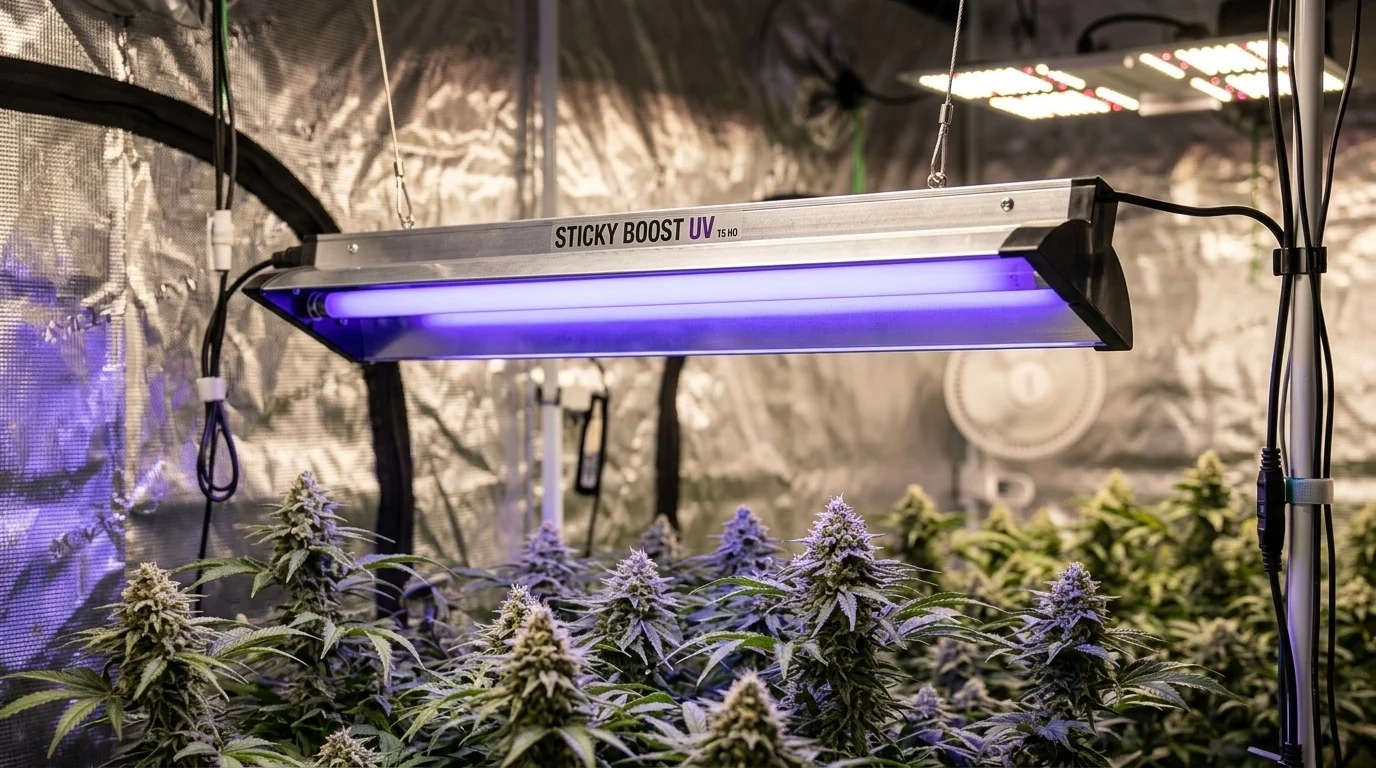
Light spectrum management is one of the most underestimated factors in indoor cultivation. Many growers invest in high-end LED systems, monitor temperature and humidity to the millimetre, and use premium nutrients. Yet when harvest time comes, something is missing.
The resin isn’t as abundant as expected. The aromatic profile is flat. Trichomes are sparse and underdeveloped.
The problem isn’t genetics. It isn’t cultivation technique either. The problem is that a fundamental component of the solar spectrum is missing: UV-B.
And without UV-B, the plant simply won’t reach its full potential in terms of resin, terpene and cannabinoid production.
Why HPS and LED aren’t enough
Traditional lighting systems like HPS and most LED fixtures don’t include UV-B radiation. Some recent LEDs integrate UV-A chips, but as we’ve already covered, UV-A alone isn’t sufficient.
Even in greenhouses, the situation isn’t much better. Glass and plastic films filter out almost all UV-B, preventing these wavelengths from reaching the plants.
This creates a massive gap compared to natural sunlight in open fields, where UV-A and UV-B are always present in balanced proportions.
The result? Plants that grow well, but never fully express their potential in terms of harvest quality.
What UV-B does to plants
UV-B radiation operates between 280 and 315 nanometres, an extremely high-energy portion of the spectrum. The plant perceives it through a specific photoreceptor called UVR8.
When UVR8 detects UV-B, it triggers a defence response. The plant enters a state of positive, controlled stress that stimulates the production of protective compounds.
Among these compounds are trichomes — the resin glands that produce and store cannabinoids and terpenes. Flavonoids, anthocyanins and carotenoids are also produced: molecules that influence the plant’s colour, aroma and properties.
But the most important response involves CBG synthesis — cannabigerol. This cannabinoid is the chemical precursor from which all others are derived: THC, CBD, CBC. The more CBG is produced, the higher the synthesis potential of the final cannabinoids.
None of this happens with UV-A alone. A combined presence of UV-A and UV-B is required to fully activate these mechanisms.
More trichomes, more resin, more terpenes
When a plant is exposed to controlled levels of UV-B, the results are visible and measurable.
Trichome density increases significantly. Resin becomes more abundant and viscous. The terpene profile intensifies, with a more complex and layered aroma.
Flavonoids and anthocyanins contribute to more intense colouration, especially in varieties predisposed to developing purple or reddish hues.
In short: harvest quality improves across the board.
There is one critical detail, however. Exposure must be controlled. Too much UV-B can overstress the plant, slowing growth or causing damage. Too little won’t activate the desired response. You need a tool specifically designed for this purpose.
UV-B against fungi and pathogens
Another often-overlooked advantage of UV radiation involves defence against unwanted microorganisms.
UV radiation helps create conditions less favourable to the development of pathogens on plant surfaces. In particular, it helps limit the proliferation of fungi such as botrytis and fusarium — two of the most common problems in indoor cultivation.
This doesn’t mean UV replaces good cultivation practices. Ventilation, humidity control and hygiene remain essential.
But integrating UV-B into the lighting cycle adds an extra layer of protection, reducing the risk of contamination and improving overall plant health.
STICKY BOOST UV: the technical solution
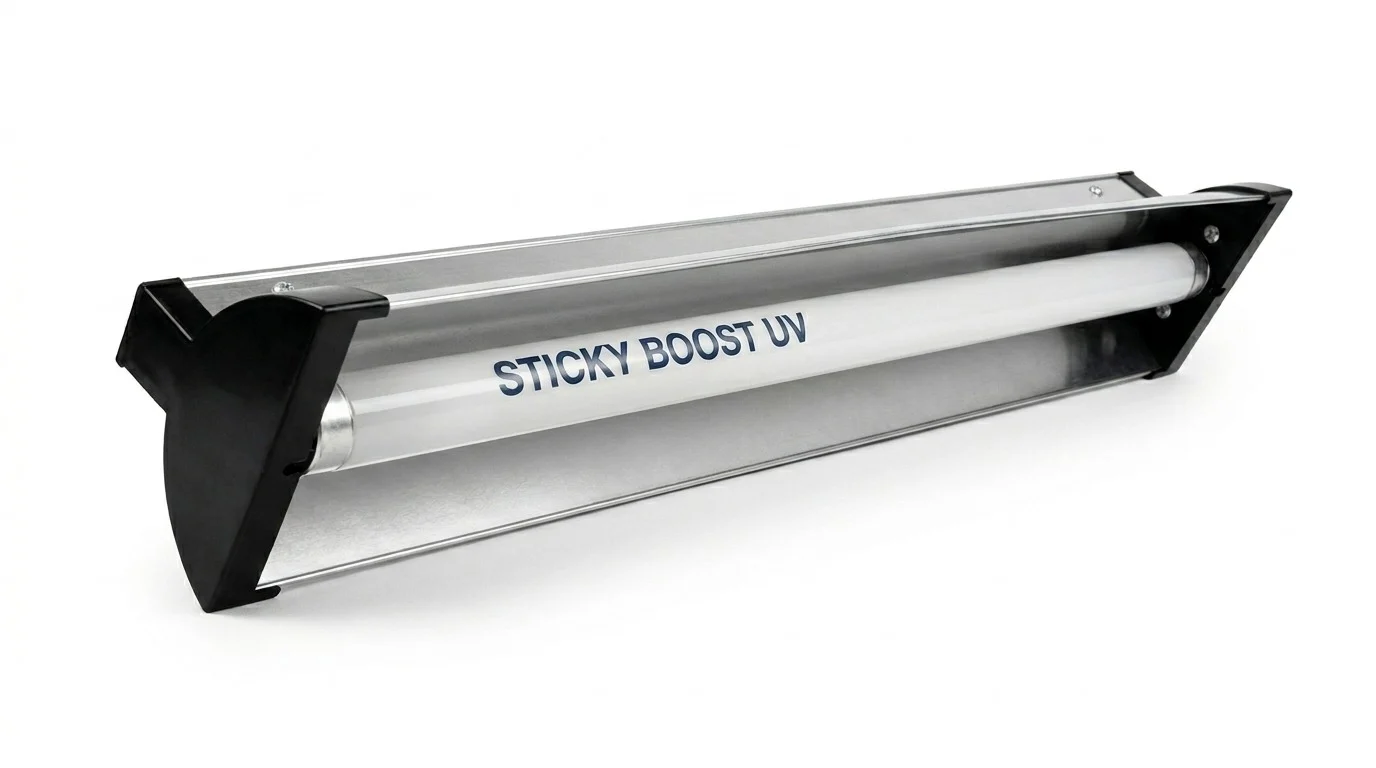
STICKY BOOST UV is a 24W T5 linear fluorescent lamp designed specifically to supplement the light spectrum in indoor cultivation.
Unlike the LED UV systems currently on the market, this lamp emits UV-A, UV-B at 12% and a far-red component simultaneously.
Fluorescent technology allows for a stable, controlled UV-B emission — with enough intensity to stimulate the plant’s response without requiring high wattage or complex configurations.
Average lifespan is approximately 15,000 hours.
The product is manufactured for IndoorLine by Sylvania Lighting, a company with decades of experience in the design of specialised light sources.
How to use STICKY BOOST UV
Correct use is essential to get results without stressing the plants.
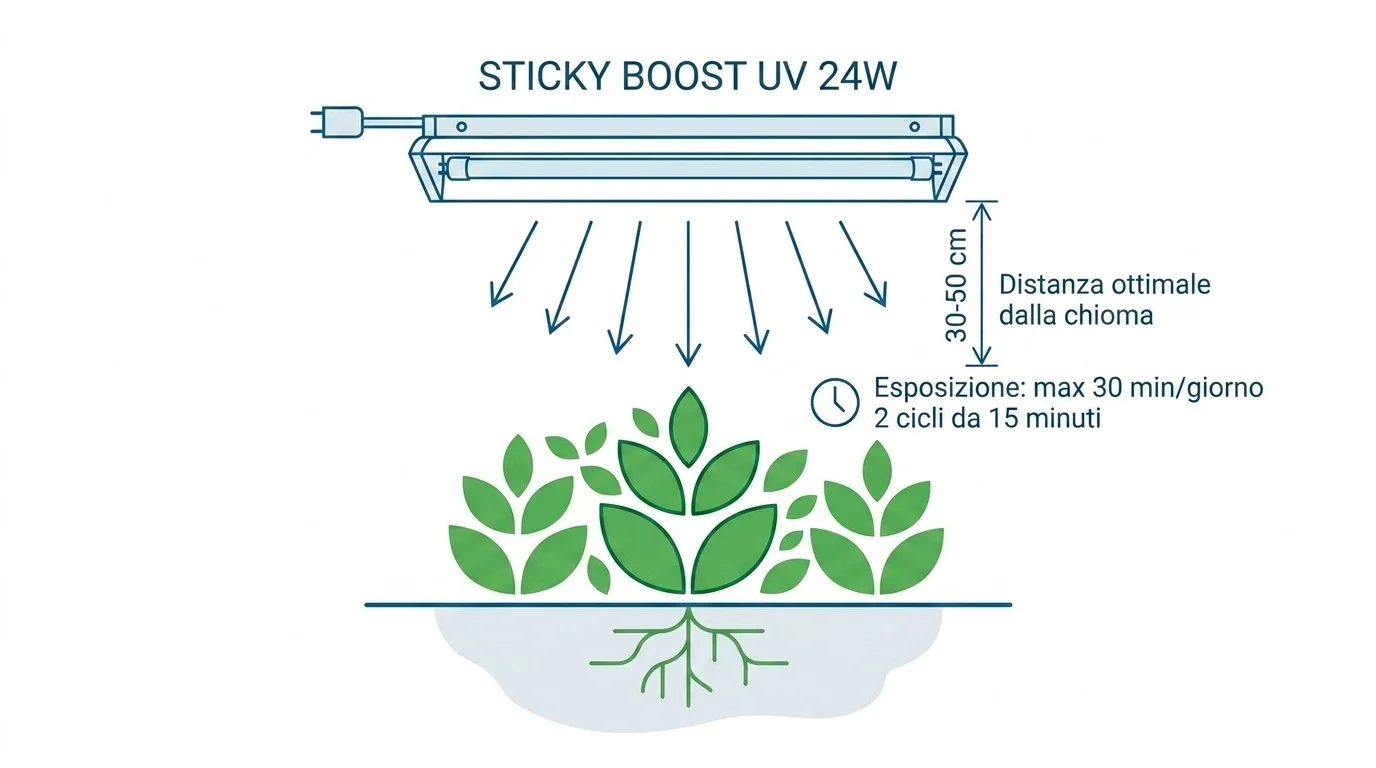
The recommended method involves a maximum exposure of 30 minutes per day, split into two 15-minute cycles. It’s important to gradually increase exposure, starting with shorter sessions in the first few weeks.
The lamp should be positioned at an appropriate distance from the canopy, following the guidelines provided in the instruction manual. Too close can cause light stress; too far reduces effectiveness.
UV-B integration should be planned according to the growth stage. During the vegetative phase, exposure can be reduced or skipped entirely. During flowering, it’s advisable to gradually increase sessions to maximise resin production.
Comparison with other solutions
Compared to LED UV systems currently available, STICKY BOOST UV offers a decisive advantage: it actually emits UV-B in significant quantities.
Compared to HPS lamps, which emit no UV, it represents a necessary integration for anyone wanting to get closer to the natural spectrum.
Compared to outdoor cultivation, it allows precise control over UV exposure, avoiding the risks associated with variable weather conditions or excessive solar radiation peaks.
In short: STICKY BOOST UV is the missing piece to complete the indoor spectrum.
Who it’s designed for
This lamp is designed for growers who want to take harvest quality to the next level.
It’s particularly suitable for those cultivating high-cannabinoid or high-terpene varieties, where qualitative differences become measurable value.
It’s also useful for greenhouse growers who want to compensate for the UV-B filtering caused by covering materials.
This is not a beginner’s solution. It requires a basic understanding of light spectrum and plant physiology. But for growers already at an intermediate or advanced level, it represents a significant upgrade.
Integrating UV-B: from optional to essential
For years, UV-B integration was considered a secondary detail. Something interesting, but not indispensable.
Today, with growing attention to harvest quality and the spread of increasingly refined cultivation techniques, UV-B is becoming an industry standard.
Not because it’s a trend, but because the results are clear. And growers who try it don’t go back.
STICKY BOOST UV is the most accessible and effective solution for integrating this component of the solar spectrum — improving quality, yield and plant health in indoor cultivation.
Frequently asked questions about STICKY BOOST UV
How many hours a day should I use STICKY BOOST UV?
Maximum 30 minutes per day, split into two 15-minute sessions. More isn’t needed. Prolonged exposure can stress plants without providing additional benefits.
What area does a 24W STICKY BOOST UV cover?
Approximately 1 square metre. It should be positioned at the same height as the other lamps to avoid creating shadows.
Can I use it during the vegetative phase?
Yes, but with reduced exposure. UV-B is most beneficial during flowering, when the plant produces trichomes and resin. During vegetative growth, you can use it for 10–15 minutes per day or skip it entirely.
How far should it be positioned from the plant?
Follow the manual guidelines based on lamp wattage and growth stage. Generally, 30–50 cm from the canopy is a safe distance. Too close can cause stress; too far reduces effectiveness.
Does STICKY BOOST UV replace my main LED?
No. It’s a spectrum supplement, not a replacement. Your LED or HPS provides PAR light for photosynthesis; STICKY BOOST UV adds UV-B to stimulate trichomes and resin.
How long does the lamp last?
Approximately 15,000 hours. At 30 minutes of use per day, that’s years of use before needing to replace the lamp.
Does it work in a greenhouse?
Yes — it’s ideal for compensating the UV-B filtering caused by glass and plastic films. In a greenhouse you already have natural light, but without UV-B. STICKY BOOST UV completes the spectrum.
Can I use it with any genetics?
Yes, but the best results are achieved with varieties predisposed to developing high levels of cannabinoids and terpenes. Some genetics respond better to UV-B than others.
Are UV-B rays dangerous to me?
Yes, with direct exposure. Always wear protective eyewear when working with the lamp on. UV-B can damage eyes and skin. Work with the lamp off and switch it on only when you leave the grow room.
 Seed Shop
 Head Shop
 Vaporizers
 Cosmetics
 Growshop
 Grow Box
 Ornamental plants
 Fans and extractors
 Pots
Pots LED lamp
 Fertilizer
 Pest control