












Manuals & Resources
Revomax Grow Room: 3-in-1 Climate Control for LED Grows
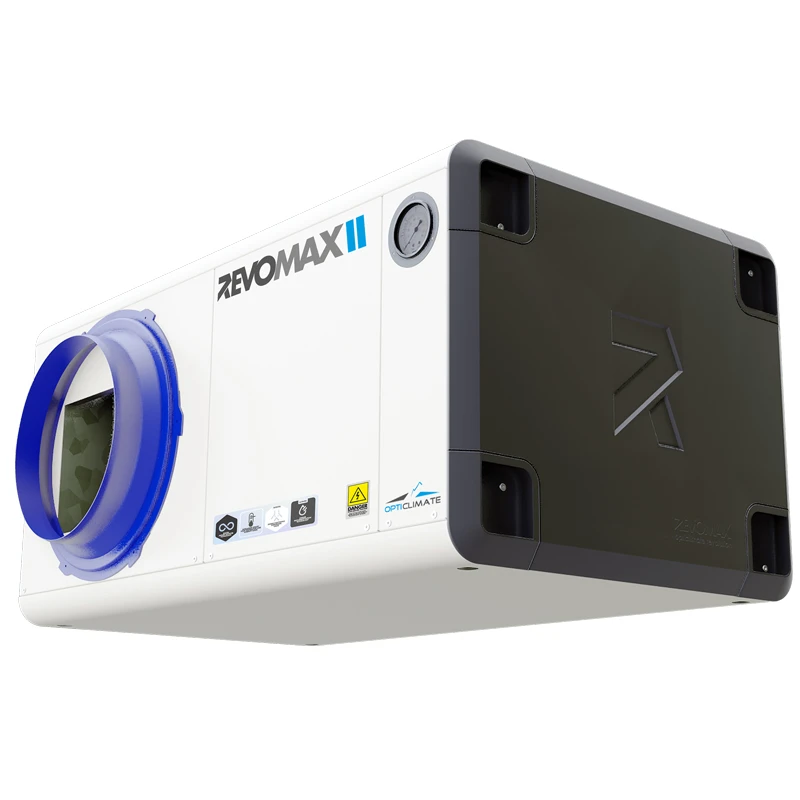
Revomax: when the problem isn’t heat — it’s humidity
If you grow indoors with high-efficiency LED lighting, you’ve probably noticed something strange. Temperature is under control. Lights consume less power. Yet humidity keeps rising beyond acceptable levels.
This isn’t a problem with your setup. It’s the new paradigm of LED growing.
With old HPS lamps, the enemy was heat. With LEDs, the real challenge becomes humidity. Managing it with traditional systems means wasting energy, creating climate instability, and compromising crop quality.
Revomax was designed to solve this problem at the root, integrating dehumidification, cooling, and heating into a single machine built for climate control in modern grow rooms.
Three functions in one system
Traditional indoor growing systems rely on separate appliances. A dehumidifier for humidity, an air conditioner for heat, or a heat pump for cold. The result is an environment that’s hard to stabilize, with high energy consumption and constant fluctuations between devices.
Revomax integrates everything into a single unit. It dehumidifies when needed, cools when necessary, and heats to maintain stable temperature. Not three machines working against each other, but a single system that automatically modulates its output based on the actual conditions inside the grow room.
This approach improves energy efficiency, reduces operating costs, and delivers the kind of climate stability that’s practically impossible to achieve with separate systems.
How energy recovery works
The key to Revomax lies in energy recovery. When the unit dehumidifies the air, it activates a cold coil that condenses water vapor. This process generates heat, which in most dehumidifiers is simply released into the environment.
Revomax instead recovers this heat and reuses it for post-heating — technically known as reheat. After dehumidification, the air comes out cooler. Without reheat, the grow room temperature would drop, forcing the grower to turn on an external heater.
With Revomax, the recovered heat is reintroduced into the airflow, keeping temperature constant without any waste. If the recovered heat isn’t sufficient, integrated electric heating elements kick in — but only for the exact amount needed.
The result: stable conditions, reduced energy consumption, and no conflict between dehumidification and temperature control.
Managing endogenous thermal loads
A grow room is not an isolated environment. There are internal thermal loads that constantly influence both temperature and humidity. LED or HPS lights generate heat. Fans, pumps and other machinery contribute to the thermal load. Outside air entering for ventilation brings variable humidity and temperature. And then there are external climatic conditions and the insulation level of the grow room itself, which change between day and night, summer and winter. All these factors affect environmental conditions such as temperature and relative humidity.
Revomax is designed to manage all these loads dynamically. The system continuously monitors environmental parameters and automatically modulates its output to maintain the set values.
When the lights turn on and the thermal load increases, Revomax cools. When plants transpire intensely and humidity rises, it dehumidifies. When temperature drops and the environment gets too cold, it heats.
All of this happens without manual intervention, ensuring optimal conditions at every stage of the growing cycle.
Why LED growing requires more dehumidification
Switching from HPS to LED doesn’t simply mean changing the lamps. It means completely changing the climate behavior of your grow room.
HPS lamps produce a significant amount of radiant heat. A large portion of the energy consumed is converted into heat, which warms the air, surfaces, and especially the leaves. This contributes to lowering relative humidity and makes heat the main parameter to manage.
With high-efficiency LEDs, the scenario changes. Radiant heat is much lower, and at equivalent power or PPFD, it’s possible to illuminate and grow a larger canopy. This can mean more plants — in some cases up to 50% more with particularly efficient LED systems.
More plants means more leaf surface area. More leaf surface area means greater transpiration. And greater transpiration means more humidity released into the air.
The advantage of LEDs is better thermal management, but the trade-off is an increase in latent load. In an LED grow room, the main challenge is no longer just dissipating heat — it’s controlling humidity.
This is why, when transitioning from HPS to LED, dehumidification becomes a central element of climate design.
The effect of the absence of infrared
LEDs have a significantly lower infrared component compared to HPS. Infrared radiation directly heats the leaves, keeping leaf temperature higher than the surrounding air.
Without infrared, leaf temperature drops. When leaves are cooler, plants tend to close their stomata — the tiny openings through which gas exchange and transpiration occur.
Closed stomata mean less transpiration, less CO2 and oxygen exchange, and slower growth. To compensate for this effect, growers using LEDs need to work with higher ambient temperatures.
Higher temperatures promote stomatal opening, reactivate metabolism, and keep the plant in optimal condition. But higher temperatures further increase the humidity load that needs to be managed.
It’s a loop that requires a climate control system specifically designed for this scenario.
Sizing: it’s not 1:1 with installed watts
One of the most common mistakes when sizing a climate control system for a grow room is assuming you need a cooling capacity equal to the watts of installed lighting. This approach worked with HPS, but with LEDs it’s completely wrong.
With high-efficiency LED lighting, the true driver of sizing is not the thermal kilowatts of the lights, but the dehumidification capacity needed to manage the latent load.
If you install 10 kW of LEDs, you don’t need a 10 kW cooling system. You need a system sized according to the amount of humidity your plants will produce — which depends on the cultivated area, number of plants, growth stage, air exchange rates, and the temperature and relative humidity targets you want to maintain.
Revomax is sized precisely on these parameters. It’s not an air conditioner with a dehumidifier bolted on. It’s a system designed to manage latent load as the primary priority, providing cooling and heating as secondary functions when needed.
What you need to size correctly
To select the right Revomax model for your grow room, you need precise information. The cultivated area, expressed as canopy — meaning the area actually covered by the plants.
Then there’s the air exchange rate, essential for calculating how much humidity enters from outside. Internal thermal loads, such as fans and pumps, and external loads, such as solar radiation if the grow room is in a non-insulated building.
Finally, the target temperature and relative humidity values you want to maintain during the different phases of the growing cycle.
With this data, the actual humidity load can be calculated and Revomax can be sized precisely. Without this data, you risk over- or under-sizing the system, leading to unnecessary costs or insufficient performance.
LED vs HPS: a new paradigm
The shift from HPS to LED is not just a technological upgrade. It’s a paradigm shift in grow room climate management.
With HPS, the limit was heat. A good air conditioner was enough to solve the problem. With LEDs, the limit becomes humidity. And humidity can’t be managed simply by cooling. You need dedicated dehumidification, energy recovery to avoid excessive temperature drops, and a system that modulates everything in an integrated way.
Revomax was built for this new scenario. It’s not a product adapted from other applications. It was designed specifically for modern indoor cultivation, where humidity control is the true critical factor for achieving quality harvests.
Climate stability and energy efficiency
Working with separate systems means constant conflicts. The dehumidifier lowers the temperature, the heater raises it, the air conditioner kicks in when it’s not needed. Each device works independently, without coordination, wasting energy and creating instability.
Revomax eliminates these conflicts. Everything is managed by a single unit that knows exactly what to do at every moment. It dehumidifies while recovering energy, heats only when necessary, and cools if the thermal load requires it.
The result is a stable grow room with consistent parameters and reduced energy consumption. Less waste, lower operating costs, and above all — optimal conditions for your plants at every stage of the cycle.
Professional sizing support
Correctly sizing a climate control system for a grow room is not straightforward. It requires specific technical expertise, knowledge of indoor cultivation dynamics, and the ability to accurately calculate thermal and latent loads.
The IndoorLine Team offers professional assistance in sizing Revomax units. This isn’t about selling a machine — it’s about designing a tailored solution for the specific needs of your cultivation.
With the right data and precise sizing, Revomax becomes the tool that allows you to unlock the full potential of your plants, guaranteeing optimal climate conditions and operational stability.
Frequently asked questions about Revomax
Does Revomax replace the air conditioner in the grow room?
Yes. Revomax integrates cooling, dehumidification, and heating in a single machine. There’s no need to install separate systems. Everything is managed in a coordinated way to maximize efficiency and stability.
Does it work better with LED or HPS?
Revomax is optimized for LED grows, where humidity load is the dominant factor. It also works with HPS, but its true value emerges with modern high-efficiency LEDs, where dehumidification becomes critical.
How does it save energy compared to traditional systems?
It recovers the heat generated during dehumidification and reuses it for reheat, avoiding the need for electric resistance heating. Furthermore, by managing everything in an integrated way, it eliminates the conflicts between separate devices that waste energy.
Is professional sizing really necessary?
Yes. Incorrect sizing leads to underperformance or unnecessary costs. Revomax must be calculated on the actual latent load, not on the watts of the lights. The IndoorLine Team provides technical assistance for exactly this reason.
How important is humidity load compared to heat?
With LEDs, humidity is the critical factor. Heat is manageable, but if you don’t control humidity you risk mold, metabolic slowdowns, and loss of harvest quality. Revomax was built to address precisely this aspect.
Can it be used in small grow rooms or only professional setups?
Revomax is available in different sizes. Correct sizing is required, but it can be used in both professional installations and medium-sized grow rooms. The key is calculating the right parameters.
What happens if I change the number of plants or cultivation density?
The system automatically modulates its output, but if the changes are significant, a recalculation of the sizing may be necessary. More plants mean more humidity, and the system must be adequate for the load.
 Seed Shop
 Head Shop
 Vaporizers
 Cosmetics
 Growshop
 Grow Box
 Ornamental plants
 Fans and extractors
 Pots
Pots LED lamp
 Fertilizer
 Pest control